Significant Others

Things have changed since I put my name to all this back in the summer. One of the sadder outcomes is that I find it much harder now to write about my mother. When she was the mother of someone nameless that was OK. Now that I am really me and she is her, I feel this hesitation, I am more careful, and there’s that word again, care. Sometimes I beat myself up for writing the book anonymously https://www.panmacmillan.com/authors/the-reluctant-carer/the-reluctant-carer/9781529029390 but if I am honest then I don’t think I could have been that honest any other way. It had to be, and whilst she thrives, which in her way she does – amazingly – there will be less I can say.

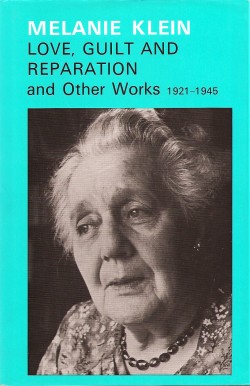
Instead perhaps I can give a shout out to another significant woman, Melanie Klein. Klein, for my money, is one of the great innovators of analytic thinking after Freud, and perhaps the foremost visionary of early, pre-verbal, infant experience and how it shapes us for the rest of our lives. I bring her up here because her thoughts on love and its (for her) intrinsic relationship to what we consider our more destructive instincts and more sorrowful feelings was of great solace, liberating even to me when I was wondering why my emotions where such a conflicting mess at times whilst, ‘caring.’

I included her in the Guardian article in July https://www.theguardian.com/lifeandstyle/article/2024/jul/06/reluctant-carer-to-redundant-carer?CMP=twt_b-gdnsaturday but it was (rightly, I think) edited out. Here though is what I wrote in case you, who come here or subscribe because you are interested in these things, find it useful:

“What is it then that we are running away from? Like much of our world when examined honestly, the caring role will not reduce to the simple good/bad splits of contemporary inclination. More than Freud it is Melanie Klein, one of his foremost successors, whose work sheds the most light on this kind of denial. She asserted that the urge to split things into good and bad was our most basic inclination under pressure, an instinctive flight from reality. Klein also said directly what dramatists had been exploring for centuries, that anxiety, guilt and aggression were, “among the essential and fundamental ingredients of the feelings we call love.” The long, slow, death-in-life of a parent is likely to elicit all those things. Part of what we are fleeing is the uncertainty. “When”, we ask ourselves, “will this end?” The corollary of this longing to know is to anticipate the death of your loved one, and if that logical thought replays as an accusation [you are now thinking ‘bad thoughts’] – then the ensuing guilt becomes another way to bid your own wellbeing goodbye. The discomfort around this is such, I would speculate, that some proportion of the violence that does sometimes happen in these situations is directed against that inner turmoil as opposed to the person prevailed on [you’re fighting your own feelings – not your ‘foe’]. As a close family member, you are both the best and the worst person for the job. You know just enough and far too much. And when you give up the job, there is a lot to reflect on.”

Her quote in my quote there comes from Love Guilt and Reparation, which is a collection of her papers. Far from an easy read, but credit where it’s due. Speaking of easy reads, I still find I need an outlet so I am going to post things here going forward:

(1) Precise Instructions For Everyday Life | Michael Holden | Substack

Please do sign up if you want more of my writing – although there will be less of mum. More news here when we get it.

With thanks

MH

Confession Time

After five years of typing in the shadows, here I am: https://www.theguardian.com/lifeandstyle/article/2024/jul/06/reluctant-carer-to-redundant-carer?CMP=twt_b-gdnsaturday#comments

It has been the proverbial, long, strange trip, not just for me but also for my family, I am very grateful to them for putting up with my invisible sniping and The Guardian for publishing the reveal piece which is fitting since it was a piece in there which got the ball rolling back in 2019: https://www.theguardian.com/lifeandstyle/2019/jan/19/dad-more-comebacks-than-elvis-confessions-of-a-reluctant-carer

Much has changed since then. Key players, Dad especially, have left the stage and others have entered the fray. If you have come here from today’s Guardian piece then the fray is best enjoyed through the book, which you can buy somewhat more cheaply (and in paperback) than the link in the piece, and from your vendor of choice here: https://www.panmacmillan.com/authors/the-reluctant-carer/the-reluctant-carer/9781529029390

But there is also much on the site which is not published elsewhere, so, if my late life hot take is your thing, dive in. It beats wasps and oysters it seems (which is saying something). You are in good company.

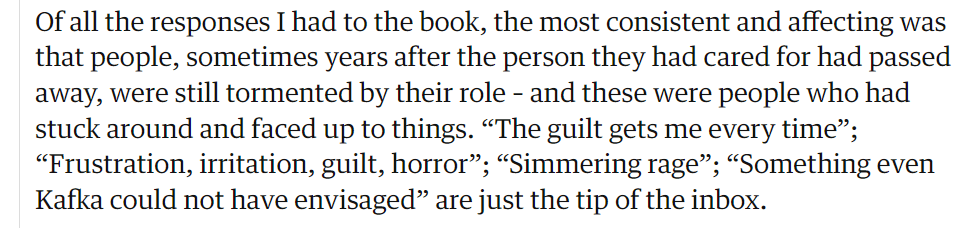
I must also thank all those of you who have emailed me from this site. Those are your words I am quoting here (below), and the drive to write this latest piece was kindled by that recognition.

If you want to know more about ‘me’ and how it came to this, I am indebted to Andew Hankinson, a soldier of non-fiction for having me on his podcast https://podcasts.apple.com/gb/podcast/michael-holden-the-reluctant-carer/id1588244277?i=1000661300505

Thank you all for reading.

Love, Michael x

PS if you like non-fiction, I would very much recommend this book of Andrew’s too https://www.amazon.co.uk/Could-Something-Amazing-Your-Raoul/dp/192224791X

Mumaggedon

Ran into an old acquaintance the other day who told me excitedly that they were now, “in renewable energy.” “Have you met my mum?” I answered. They were somewhat baffled but I was serious. Whatever force is driving my 95-year-old mother into another winter, it seems more reliable than the sun.

The obvious and traditional answer to this apparent mystery of maternal power would be food, and the time-honoured process of metabolism by which it is converted into energy. Except that last time I made dinner mum said, “I’m stuffed” and fed the rest of her portion to my brother’s dog. The canine connection is apposite since the miraculous energy puppies access from a handful of dry biscuits seems to stem from the same mystical font as my mum’s late life flair for transmuting the occasional mouthful of this and that into almost a century of survival.

OK – she isn’t chasing any sticks, but it is still remarkable. Until last month I was part of a trio of friends, all of whom had surviving mums in their mid-nineties. Over the course of a week, a week we now refer to as ‘Mumageddon’ both my friend’s mum’s died. It feels useful to note how upsetting I found this, and I think that was because my own mother’s mortality is much on my mind – or perhaps I should say I am constantly maintaining my defences around it – whereas the passing of my friend’s mums, one in particular, really took me by surprise. So I am alone then – last mum standing – though not as alone as I will be.

Meantime I take mum’s survival and relative stoicism as a lesson in itself – if she can do this, so can I. In an effort to get my head around where her head is at I have been studying Oliver James’ book ‘Contented Dementia.’ Contented Dementia: A Revolutionary New Way of Treating Dementia : 24-hour Wraparound Care for Lifelong Well-being : James, Oliver: Amazon.co.uk: Books Since my own book came out https://www.panmacmillan.com/authors/the-reluctant-carer/the-reluctant-carer/9781529029390 James’ has been frequently recommended to me, and so, despite some resistance to abandon my own ‘make it up as you go along’ policy I decided to buy the book and take some advice.

At the book’s opening James outlines three points as the foundation of his approach, one of them is “always agree with everything they say, never asking questions.” As you will have instinctively understood, this is as not as simple as it sounds. “We haven’t seen much of Dad lately,” says mum. Where once I might have pointed out gently that her husband – my father – passed away two and a half years ago, I adopt the new strategy instead and answer. “I haven’t seen him, and I’d be worried if I did.” This works, Mum laughs, and does a plausible impression of seeing a ghost. This would not have been the case if I had simply set her straight, however gently. So this method is much in favour now, although compared to some of the allegations against reality that I hear these days – that was an easy one.

The book also explores how dementia gets in the way of forming new memories. I realise that something similarly dementia-like is happening to me thanks to mum’s carer’s addiction to greatest hits radio. The non-stop eighties soundtrack that accompanies my interactions with my parent in her nineties adds the emotional complication of making me feel as though I am sixteen. This is amplified by the fact this is taking place in the same house I lived in when I was sixteen. So I do the elderly stuff while another part of me is convinced by music that I am going out for the evening. It is an odd juxtaposition until I realise what teenage and present predicament me have in common is that we are both trying to work out what women are thinking. I would page Dr Freud but I think he’s busy. I must make do with Dr and the Medics, and the beat goes on.   

“I’m gonna deal with the bigger insult, man. The heat…”

Bosch, Hieronymus; An Angel Leading a Soul into Hell; Wellcome Library; http://www.artuk.org/artworks/an-angel-leading-a-soul-into-hell-125754

Recent high temperatures have proved divisive – for every smear of lotion and lick of ice cream there is the sense that we are also heading into – or perhaps already inhabit – some disastrous collective terrain. 

As ever my mother’s house offers a troubling insight into all our potential futures – in this case a planet where it almost never falls below 30 degrees. I am well accustomed to mum feeling cold in winter when the house is well heated. My late father was something of a pioneer in this regard, but now his surviving spouse is convinced that this record-breaking, life-threatening summer, is just not that warm, and this is proving tough on those of us who must attend her. 

The problem is compounded by the fact that she has shifted her headquarters. For years she was based in the living room, but for the last few months mum has insisted on sitting in the conservatory. Even plants struggle to survive here in the summer. If you bring her a tea and she falls asleep and fails to drink it, even after an hour here it will still be warm. 

Her present live-in carer hails from Africa but even she says it is worse than being close to the equator. And she has a point. Sitting down and trying to talk with mum in there is like getting a workplace review from Satan. Although they do say the devil knows your name, whereas mum sometimes does not, so perhaps I am being unfair. 

Fairness though, is a relative term. I look online. There are lower limits on the minimum temperature for a workplace but no upper ones. Legally we are fine. Physically we are in danger. 

Sit by an open window and mum will warn you that you might get a chill. This is as heartfelt as it is deluded, but it is also a polite way of expressing her own anxiety that she might somehow perish here, like a snowman on Venus. Meanwhile out on the molten driveway, salamanders tap out and surrender and crickets scream for rain.  

My humour, of course, is a coping mechanism. It is a skill I learned largely from (and maybe for) my mother, and it is sad sometimes to see how she is now less able now to deploy it. 

For her, though, the situation is as profound as it is subjective. Temperature and our perception of it are separate matters. The sun is out and amplified through the glass roof of our extension, yet its tenant shivers in her very soul. If Joan of Arc was 94, her stoicism might have been less surprising. God might know our name, but will he pay our utility bills?

Come back, we have paperless billing.

Meanwhile, the heat beats on. The carer and I open windows, mum trundles past and tries to hook them closed with her walking stick, like a mad shepherd. “I’ll freeze,” she hisses as we steer her away from the fresh air she has come to fear. Part of me understands, but another part of me – the part that wishes to live, presumably, does not. It is so hot that at one point I wonder, is she trying to save on the cost of cremation? Numerous factors stop me from saying this out loud, more down to fatigue than discretion. Even when it’s cold it’s hot in here these days, for we are also burning money.

Then I wonder, is she evolving? If the planet is heating up, then not feeling it is perhaps an adaptive manoeuvre? I have been in the elderly realm a while now and, believe me, stranger things have happened. 

When my father was in his late eighties I sat with a consultant who stared long and hard at an X ray before announcing that a hole in dad’s lung, of some years standing, appeared to be repairing itself. This minor miracle was a of little help in the bigger picture but it does prove what I can see now is becoming one of the persistent refrains of this experience – in the end, you just don’t know. 

Knowledge and power are not always hand in hand. There is freedom sometimes in letting go of wondering why things are as they are – the quest for light, for illumination, and certainly, certainty, has its limits. In life and in our house especially – sometimes we fare better in the shadows.

An earlier version of this column appeared on the Spring Chicken website: https://www.springchicken.co.uk/article/adventures-of-a-reluctant-carer-some-like-it-hotter

Thanks to A Tribe Called Quest for the headline.

The Son Who Fell to Earth

Orifice politics. Busy times. I’ve had two eye surgeries and a robot in my colon (purely for health reasons) in under a month. Mother, though, is fine. I hear the voice of Psycho’s Norman Bates – or rather Norman Bates approximating his mother’s voice – each time I type ‘mother’ lately since my own parent appears to have taken on the timeless power of his. Two big differences, mind you. Mine is alive and I haven’t killed anybody. At least, not yet. Things can still happen fast, even when you move slowly…

I spent March on the sofa, in hospital or the bathroom. My infirmity means that my share of the care has been offloaded onto my siblings and the team of carers that together provide round-the-clock surveillance of the Old Lady, now ninety-four and a half.

A surgeon tells me I must try not to move my head for five days. Shored up by pillows and remorse I am Whatsapped a video of my mother doing an impression of Marlene Dietrich. I have never heard her do this before. It’s pretty good. But how is she developing new material while I can’t even sit at the computer? What has gone wrong?

“All bets are off,” says my friend T, whose mother is ninety three and in a care home which grows more expensive by the month. The idea that either of our parents might pass away has become something so distant through persistence and deferment that we have exhausted all presently accessible forms of sadness and instead sustain one another through a series of bleak jokes. We’re on a drip, emotionally speaking.  Perhaps we should bet on when it will happen? We will both need the money after all. “I could ger Paul in on it…” texts T. Paul is in the same position. This would add to the prize fund. But then I wonder, is this is a joke, or the beginnings of a national strategy? Few things feel surprising anymore – but then you get a Marlene Dietrich video.

I prod at my phone without moving my head unduly. It turns out the world’s oldest woman was 122. If Mum lives that long I’ll be 80, we’ll be so skint I’d have to take her on the road, on tour to make money. At this rate through I will die first, or she’ll be pushing me. Perhaps that’s the twist, the thing people will queue up for – ‘and she takes care of him…” Form an orderly queue.

The woman herself though knows that I am ill. While she can’t remember quite why or how I have come to harm some deep, maternal bell has been rung and now she has her carer call me every day. “Come back whenever you like!” says Mum. “I can’t move,” I answer. She can’t hear me. Checkmate. “You can fall out of the sky anytime,” she says – an invitation that sounds like a warning.

Suddenly I see all kinds of things: Bruegel’s Icarus https://en.wikipedia.org/wiki/Landscape_with_the_Fall_of_Icarus, Nic Roeg’s Film https://www.youtube.com/watch?v=KarWCgIw3Wk&t=1s , Auden’s poem https://www.poetryfoundation.org/poems/159364/musee-des-beaux-arts-63a1efde036cd, Walter Tevis’ novel, “The Man Who Fell to Earth.” Science Fiction, technically speaking, but more fundamentally a story about not belonging and drinking yourself to a kind of death and wanting to get home. Then it hits me. Because I can’t go home and see her for the first time in years – because the whole business of who we are got turned into work – I find I really miss it and her and all the rest of it. Few things are surprising anymore – but that one really got me. Falling in love again. Who knew?

Thanks for reading. Paperback cometh. https://www.panmacmillan.com/authors/the-reluctant-carer/the-reluctant-carer/9781529029390

“All things are ready if our minds be so…”

This is about the risks and limits of language, and the power hidden inside it and ourselves. This is about what words can and cannot do.

Image: A seated man sharpening a quill pen. Engraving by C. Guttenberg after F. van Mieris. (Mieris, Frans van, 1635-1681) Credit: Wellcome Collection, Attribution 4.0 International (CC BY 4.0)

Exhibit A: “Grief.” A term scarcely fit for purpose. So personal, so vast, so all encompassing, and yet, passing. I was going to say that so few letters should not do so much heavy lifting, but then you think of “love”, “God,” “I,” and realise, we do it all the.. (and here comes another four-letter inadequate) “time”.

Exhibit B: “Dementia.” That we have one word for everything under this umbrella is (to use another one) “insane.” From “where’s my keys?” to endgame Alzheimer’s, there must be a kinder phrase. Something with some hint of implicit dignity, “dementia” seems like it’s in a hurry to take things, to relegate the whole business. Like the word itself is uncomfortable with the process it refers to, and seeks to shoo it away. This hurts, when it is applied to you. I’ve seen it happen. We can, I feel, do better. Besides, knowing things can be overrated. Memory too. We’re throwing our own fear onto the subject because we don’t know what else to do.

A while ago some music playing on Radio 3 Radio 3 – Listen Live – BBC Sounds stopped me in my tracks and filled me with – or reconnected me – to some outrageous sadness and I couldn’t quite place it, but I knew it was old, and had something to do with me and my father. This was it:

Even now, months from that recognition, I need to sit down when I hear it. If there is no one about then, I will cry. It might be the same if someone were about, it just hasn’t happened yet and I wouldn’t want it to. This is as intimate as I can let it get, for now.

Once I connected the music to the movie it began to make sense. My dad, who had left school aged 14, loved Shakespeare. And this infection became a part of me, by accident or design or osmosis and his determined dream that I should have more time in education than he. Either way, those words, centuries old, would become part of our connection. More, somehow and sometimes, than the everyday ones we used to say.  

He loved Kenneth Branagh’s movie of Henry V particularly. We watched it together, once I think, on his VHS, and I have seen it many times since but it is always, for me, about me and him. And so that music now takes me back to us. Before I even ‘know’ what’s happening. Closer in recollection, or just clearer, maybe, than we were in real time.

This is another property of grief – that it can pull us out of time and locate us with the lost somehow in some kind of impossible union. We are ‘there,’ and this is closer then, than being apart. This impossible touching is the addictive component perhaps, the taste of stability that provokes us to swallow and then replant, plough and devour again our mourning when grief gets complicated. Or when something just comes out of the radio, junks the narrative and grabs you by the soul.

That music of Patrick Doyle’s scores one of the movie’s, and Shakespeare’s most famous scenes, the King’s speech on the eve of Agincourt. Branagh does an amazing job with it, his voice an instrument that finds the music in the words and plays it, in effect. The result is a release of inordinate power. It speaks to the latent forces in us, the secret parts. Home to power and powerful sadness. This is why the speech is used to rouse groups and teams facing “fearful odds” to all kinds of action, for better and for worse, I’m sure.

The irony here – and this might be implicit to its brilliance – is that it is both a call to unity and conflict at the same time. This is very human, we are seldom more together than when we know what we are up against. Of course this is also what makes it so tempting, so dangerous and so common a tool for those who must make others take action on their behalf. This is also why it makes me think me think of care, dependency, and so, again, my father.

“strip his sleeve and show his scars”

Once, he fell, and I could not for the life of either of us lift him. We sat there bloody, and entwined (he bled so easily) on the bathroom floor, urging one another on for multiple attempts (to call for help meant to call an ambulance, and that meant hospital, and he was afraid of that, so…), moaning, falling, trying again until, using the toilet as a kind of lever, I stood, straining, and somehow bought him with me.  So our battle was not glamorous, our opponent foreign to us or our story told. But it was something, and splendid in its way, I came to understand.

That’s from my book https://www.panmacmillan.com/authors/the-reluctant-carer/the-reluctant-carer/9781529029352 . But the more I reflect on Shakespeare, the clearer our scene on the bathroom floor becomes.

I wished for help, it wasn’t coming. It was just us, against gravity and frailty and our entwined mythologies of what we could and couldn’t do. I stripped his sleeve (of his pyjamas) I saw his scars, and brand-new wounds upon them. And up we got, the two of us. We few.  And of course there was for a second something repulsive in it, this messed up, ailing, unglamourous figure and his uncertain son. But then I saw the deeper truth of it. We were one, in a way, through purpose. Father by blood and now bleeding, and son, made brothers by inclination. Since he did shed his blood with me and so, “Shall be my brother; be he ne’er so vile.”

The point, for all the warlike connotations of that speech is that your brother can be anyone – and so is everyone your brother. “This did the good man teach his son”, and I never even realised it was happening. For all they cannot do, words somehow did all that, and then did all this too.

Death & Taxes

Nothing, it’s said, is certain except death and taxes. But these days if you invest in one you can sometimes dodge the other.

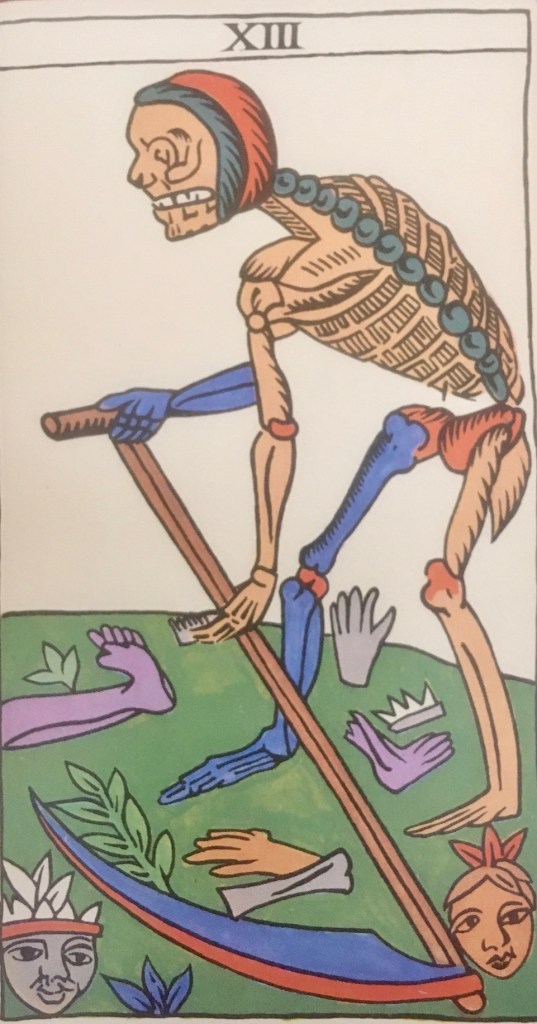
Let’s start with death, which, being unavoidable, we prefer not to discuss. In the Medieval tarot, the 13th card doesn’t even mention the word. The scythe-wielding skeleton, the severed body parts, these are there to get a message to us. Or maybe from us. What you take those symbols to mean (and I would suggest what’s being depicted is as generative as it is destructive) is entirely a matter for you. Our swerving any mention of the endgame is a cultural preference which has only accelerated since the middle ages – but I was still surprised how hard it was to get anyone to talk about it in my father’s care home in 2021.

I say my father’s care home – I mean the home in which he died – who actually owns the place is another matter, as we will see. While he was alive and judged to be “participating in activities” like swallowing and breathing – and thus too vital for financial aid – he (or rather we, on his behalf) paid north of 1.5K a week to keep him at the facility.

He was transferred there directly from hospital.  The NHS found him the bed and funded his first six weeks of care – we had no say in where he went. We, he, and the system, just wanted him off the Covid ward. Also the place was nice, you could see, more or less where all that money went – though not, it turns out, where it ended up. When someone is as sick as he was and has savings you are so relived they are well looked after that a sum of money that might blow your mind and break the bank in another scenario seems fair enough. It’s worth mentioning that if he had not had the money or he had lived a little longer then the Local Authority would have had to pick up the tab, and in the end, that’s me and you. In the end, where all that money goes really matters.

Before he died though it was hard to get anyone at the home to talk about dying, his death or if and when and how it might happen, and for that kind of money you might think you are entitled to some plain speaking.

“Dad”, they would say, “is doing very well today.” Or “Dad is confused.” “Don’t say Dad,” I used to think, “he’s not your Dad or some identikit, every-Dad…” but I never spoke this out loud and I got the sense that even if I did it wouldn’t matter since this was the language of the place, the lingua franca, as they say. And they said, ‘Dad’ all the time about half the people in there, but there were other words that were never spoken and death was first and last among them. 

The juxtaposition between years of caring – in which death is much in mind and was in my Dad’s case much discussed, especially by him (see book for details https://www.panmacmillan.com/authors/the-reluctant-carer/the-reluctant-carer/9781529029352)

And then this place where death had been verbally banished, felt strange. But then he and I like all of us in the end, were only visiting. Every world has rules of its own. 

I listened to a lot of prognoses and treatment plans, but no one ever seemed to touch on the big question – how long has he got? The senior nurse would have a kind of giggling fit if I really pressed him for some sense of how things might pan out. In the end they would refer you to a doctor who was never around. This person, they said, would have the answers. But this person is not here to tell you them.  

As the weeks went by and the money and the dignity drained away – as did my sense of what constitutes either, (not entirely a bad thing, FYI) I found myself reading a book by Robert De Board called The Psychoanalysis of Organizations.

The Psychoanalysis of Organizations: A psychoanalytic approach to beha (routledge.com)

There is a chapter on hospitals and care homes which says: “The task that society assigns—behaviourally though never verbally—to these institutions is to cater for the socially dead during the interval between social death and physical death’ (Miller and Gwynne 1972:80). Carrying out such a grim and painful task must inevitably create intense stress and anxiety, which affects not only the staff but also the inmates.” 

To make the job manageable the staff deploy what psychologists call ‘social defence mechanisms’. “social defence mechanisms arose because of the inevitable death of the inmates. Using general systems theory, an institution caring for the chronic disabled has only one export, and that is dead inmates, and this is bound to cause intense anxiety among the staff.” Denial is a defence mechanism, and this, I realized was what was happening at the home. In order to cope with so much death, they had stopped mentioning it. In order to be so intimate with those with little time, they seldom used their names. I understood it then, and dropped my objections, let them do as they do. They were kind too, and that is the main thing. When the money’s gone, it’s gone. Then one afternoon, all alone, (the last thing he wanted (‘I expect my elderly parents to die – but to suffer alone?’: the truth about caring through Covid | Family | The Guardian) my father was too(Good Grief – The Reluctant Carer) and, for a time, I denied that also.

Anything we run from is always monetizable. Where there’s muck there’s brass, and when the lights go out certain forces cash in. When someone dies the machinery of the state shakes the tin one last time to be sure there are no back taxes and if the deceased is leaving any money then there is tax on that too.  The money it might have taken to keep them alive in some semblance of decency, in what De Board called that interval, the one between social death and actual death, that, it turns out, is less scrupulously scrutinized. I did worry that my dad’s savings, his house, all of which sprung from a salary on which tax was paid might be siphoned off by a corporate arrangement that didn’t pay its dues here and kept its staff in a zero-hours headlock, but in the end it was all too dramatic to make those kind of checks. And how do you check that stuff anyway?

Happily The New Statesman have the skills and patience to find out.

What they found was what I feared. Some British care homes are kind of portal in which a proportion of families last funds or four figure weekly per-patient cash drops from the NHS are ultimately funnelled offshore. Not the actual home my father was in, it turns out, but several owned by its parent company, one of the so-called, ‘big four.’

So death we must accept, or good luck with the defence mechanisms. Being rinsed personally, nationally as we do our best around it… we don’t have to stand for that, do we?

Marvin Gaye sang that there were only three things for sure, taxes, death and trouble. When the first is a avoidable, the second inevitable, the third might be all that’s left to us to address the situation.   

Marvin Gaye – Trouble Man – YouTube

This is the day…

From slips and slops to all good bookshops in just three years…

Since 2019 few things on the planet have gone to plan, and yet, this book, our story, my story and I hope in some sense yours has made it through the vortex of viral and violent twists in our history – which is more than can be said for its particpants, but that’s another story…

This one is now officially for sale. Pick your online vendor here: https://www.panmacmillan.com/authors/the-reluctant-carer/the-reluctant-carer/9781529029352

There’s a summing up of some key points from me here:

https://www.panmacmillan.com/blogs/lifestyle-wellbeing/3-things-i-didn-t-expect-to-learn-whilst-caring-for-my-parents

A lovely extract from the book in last Sunday’s Sunday Time’s magazine here: https://www.thetimes.co.uk/article/gout-insomnia-and-nudity-the-reality-of-caring-for-my-elderly-parents-9g5b5qkcr?utm_medium=Social&utm_source=Twitter#Echobox=1655593736

Cutting edge politcal analysis of the care criss from myself here:

You can listen to the fantastic William Andrews reading the audiobook here: https://www.amazon.co.uk/Reluctant-Carer-Dispatches-Edge-Life/dp/152902935X/ref=sr_1_1?keywords=9781529029352&qid=1655972755&sr=8-1&x=0&y=0

And for old times sake, here is the 2019 Guardian piece which set the whole thing off: https://www.theguardian.com/lifeandstyle/2019/jan/19/dad-more-comebacks-than-elvis-confessions-of-a-reluctant-carer

A startlingly positive review in The Mail

https://www.dailymail.co.uk/home/books/article-11059147/The-reluctant-carer-gave-mother-father-end-life-care.html

N.B Beware comments section in above…

So now you know what’s a foot – and something of my father’s feet, perhaps. Use yours to visit an earthly bookshop if you like.

Buy multiple copies and have your front room look like mine…

Thank you for reading, thank you for buying. Thank you for letting me briefly sell more books than Tyson Fury. And maybe, like a fighter, we can get back into the ring and take a swing at him again…

This is the day, after all:

The The – This Is the Day (Official Audio) – YouTube

Are we here?

Mum, don’t turn around, but…

Life, being life, throws humans one big question way before we can answer it. Evicted from the warmth. Thrust, wailing, into the world, aware suddenly that we ‘are’ and then afraid that we might not be, the first thing we are seeking in our caregiver’s eyes once our own have truly opened, is some reassurance of our being real. “Are we here?” is how we might articulate this. If we are lucky then someone sticks around and looks back at us as we learn to look at them – meaning, ‘yes we are’.

Congratulations, you have arrived.

We learn to stand and talk, but those inarticulate, imperfect exchanges repeat throughout our lives. That search for self, for meaning is part of what is happening if you ever start writing without a goal in mind. As I did, five years ago. Putting down words without knowing why except that it had to happen. It was a sense making exercise – a rhythm beaten out against the cell of my perception. Whether it was published or folded up and thrown away in a bottle, the statements and the questions were the same as before I had language to say them: Are we here? OK, then why? And what next?

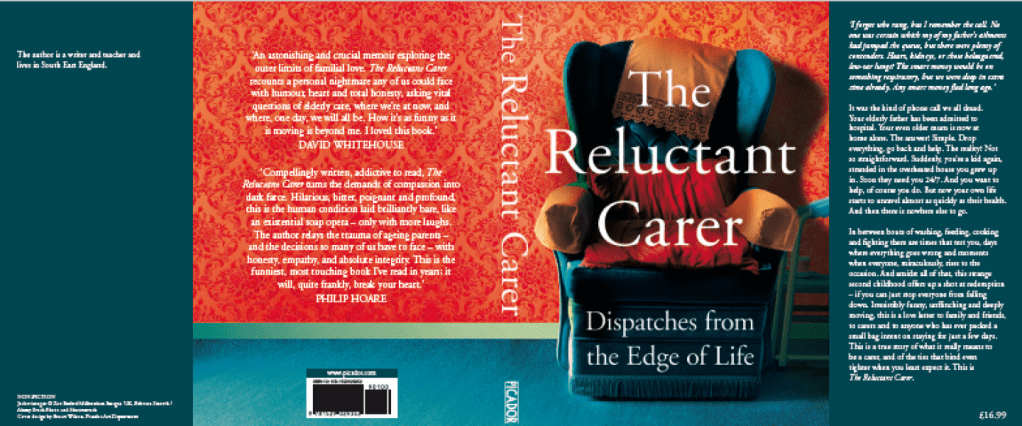
I hope you are still reading because after the long, existential preamble the reason I am writing this is to thank you for doing so. In particular the subscribers to the site, the responders to the posts and the Twitter faithful. I wrote, and by reading you answered. You said it was real, and though unknown to me in the beginning you are a reason why. I was looking for proof, and the attention you paid was the evidence required to continue. Now the book is upon us, all kinds of people will be coming on the ride but before opening up the cabin for general boarding I wanted to thank you. Here’s what the book will look like – more or less. It is very much yours, although you will still have to pay for it – life having not just questions but ironies too.

You may pre-order it here: https://www.panmacmillan.com/authors/the-reluctant-carer/the-reluctant-carer/9781529029352

The hereness of things is very much in mind at home where Mum’s perception has declined or advanced to a quantum level. Every mealtime is a new paradigm. Here’s one I call Schrodinger’s soup – after the famous physicist who posited that a cat in a box might in theory be dead and alive at the same time.

Me: “Do you want some soup?”

Mum: “If there’s not enough then I don’t want any but if there is some soup I would have some.”

Me (showing her the tin) “Do you want some soup?”

Mum: “No. Unless there is some.”

Me: (close to losing it) “There is soup.”

Mum: “Then yes. If it’s there”

She reads mainly poetry now. I fancied this was a late life shift in perception, some glimpse of meaning beyond the sense and sentences of prose. What I realised is that she can no longer remember the plots or details of longer stories – except the furthest reaches of her own. 1932 – no problem – 13.02 today – not so good. I wonder should I tell her she is in a book she might not understand? That the woman who looked back at me and let me know that I was real can still recognize me is wonderful – that she taught me to read but perhaps will never grasp what I’ve written about us… there’s an irony I can’t yet fathom. Life, being life again.

Good Grief

I am a creature of habit, much like my father, which is how come I was stirring a risotto when I found out he’d broken his ninety-year habit of staying alive. Some people nowadays think you can leave risotto alone, here, we do things the long way round.

My sister called. She calls a lot, with a flair for doing so when I am doing something. I didn’t pick up but she kept ringing, then the landline and then my mobile again. This is not an unusual pattern. The banalities of life, laundry for instance, burn as brightly in her mind as the big stuff – so that was what I was expecting – something like “I’ve got Mum’s towels,” but instead she said our father had died. The prior months had been so consumed by the logistics, costs and consequences of his survival that I had quite forgotten this was where it was always heading. For all the fatalism and dark humour, near misses, planning and pragmatism, it still came as a surprise.

Nothing to see here, and less to say about it.

Death was not so much the elephant in the room but the room itself was all elephant, or the room – Dad’s room in the care home – was within the elephant – you can look at it any number of ways – and getting stuck in and then rebuilding metaphors and analogies is what I do – not for fun so much as automatically. The more I write – or my brain writes — which it does even and perhaps especially when I am not at a keyboard or within reach of a pencil – the more I have come to suspect that the drive to write was formed to make sense of the world. The primary sources of such behaviours are primal fears of abandonment which in early childhood mean prolonged absence and, by extension, death of a primary caregiver. So now that has finally happened, fifty odd years on from when the notion first rattled my cage, and here I am writing about it. What do you know? I wonder about free will sometimes. Sometimes it seems like life has nothing to do with ‘us’ at all.

I went into the front room, sat with Mum and told her that her husband of sixty-five years had died – there was no easy way to frame it and she is deaf so it’s hard to be subtle but what she said was—

“I didn’t think he was that ill!”

Which — given that he had been that ill for four years, left the very room in which we sat on a stretcher and had only been visible through a window and then through masks in a medicalized institution which did a fair job of looking like budget hotel – how could you think he was anything but “that ill.” I had to laugh, but then thirty seconds earlier I was surprised too. Still, “that ill.” How ill do you want him? 

At the long edge of life, at least in this house, mortality became so normalized, or maybe so hidden under the minutiae, the moment of passing is so completely outnumbered by the billion moments of its planning and avoidance and conception that we just said ‘oh, death, that thing…’ like it was something we had meant to pack only to realise we had left it elsewhere but then of course, thank God, we start to cry.

I should say that what I am talking about is a difference category of bereavement from that attending deaths premature, sudden or somehow wrong. At ninety, under these conditions – on whose behalf would one be resisting such a truth? Not Dad’s – whose last months were everything he never wanted though he made the best of it. Not mine – who had so many times had to accept my own wish that this day should come –  this wish becoming a rational conclusion so frequent, so divested of its innate charge that you couldn’t call the attendant feeling or the lack thereof ‘guilty.’

We went to see for ourselves. They had laid him out nicely in the home, in his bedroom tucked into the bed he had never been able to rise from. Flowers in his hands. The night staff almost bashful, waiving the regulations. They could have made us do a flow test in the carpark as per and we would have accepted that but I am thankful that they didn’t. You don’t need fresh material for grievance while grieving. It will get in the way.

“Oh” said Mum. No way to deny what was before her. She took his dead hands in hers and said, “you did your best.” That was almost too much for me because it was true and I think an example of real, practical love and its component forgiveness and it wasn’t long before we were back in the car and I was wondering if anyone could say as much of me.

I dropped Mum at home and bought a bottle of good scotch from the shop just as they were closing since this was Dad’s favourite drink and it looked like a long night. Then I went back and heated up the risotto and despite my absence or perhaps because of it – like it too had a parent called away from home– it was fine and so perhaps would I be.